
San Francisco City Directory Collections and Years
San Francisco has a deep city directory shelf. The main run is available as microform for 1850-1960, print for 1875-1982, and a year-by-year online run for 1850-1982. Reverse directories move from an address to a listed adult, telephone books preserve subscriber clues, and older street lists help before a true reverse directory existed.
| Collection | Years | Where Held | Access |
|---|---|---|---|
| City directories | 1850-1960 microform; 1875-1982 print; 1850-1982 online | SFPL M&N Center and year-by-year digital page | Microform, print, and online access |
| Reverse directories | 1953-current; Haines 1976-2021 | SFPL M&N Center | Print address-first lookup |
| Street lists | 1933; 1936; 1940 | SF History Center | Print, online, and microfilm by year |
| Telephone books | 1899-1992 microform; 1921-current print; LOC 1901-1975 | SFPL and Library of Congress | Microform, print, and digitized volumes |
| Blue Books | 1888-1931 | SF History Center | Print and online historical collection |
| Voter registers | 1900-1968; San Francisco address search 1900-1940 | Ancestry Library Edition onsite | Library-only historical search |
| Census schedules | 1852 state census; federal through 1950 | SFPL, NARA, Ancestry, and HeritageQuest | Online and onsite copies vary |
| FamilySearch county images | 1824-1997; 1,036,854 images | FamilySearch collection 1402856 | Free account or affiliate-library access may be needed |
| Sanborn maps | 1886-1991 | SF History Center and licensed digital collections | 1886-1950 online; later years in print or microfilm |
The online run is broad but not complete. Missing online years include 1851, 1855, 1857, 1866, 1870, 1947, 1950, 1952, and 1979. A blank year is an access gap, not proof that a directory was never printed. Check microform or the physical shelf before stopping.
Match the collection to the question. A name entry can place a principal adult at a street in one year. A reverse directory tests a known address after 1953. Sanborn maps show the built setting, not a household roster, and FamilySearch does not change what the original image says.
The San Francisco History Center collection page shows the local archival setting behind these city directory holdings.
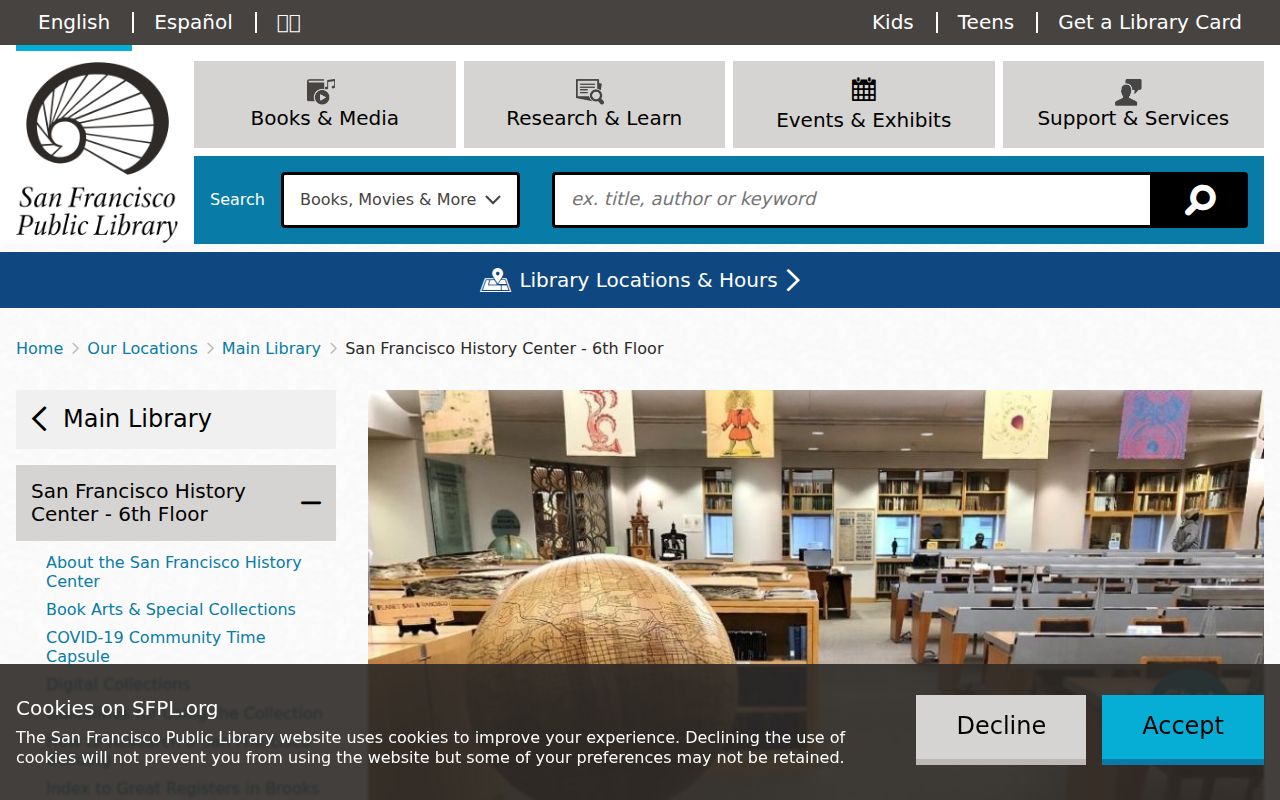
The sixth-floor archive matters when a catalog record points to a card index, map, folder, or non-circulating volume rather than a scan.
The San Francisco Publisher Spine
The publisher spine begins with Kimball in 1850, A.W. Morgan and Parker in 1852-53, and LeCount & Strong in 1854. Colville and the Harris, Bogardus, and Labatt editions appear in 1856. Langley runs from 1858-79 and 1880-95; Crocker-Langley begins in 1896, followed by Polk's Crocker-Langley in 1936-46 and Polk from 1948 or 1949 through 1982.
These names are a finding aid, not a simple chain of replacement. Editions can overlap, and early Bishop editions are part of the competing landscape. The 1949 Chinese Directory is a key special holding. Preserve alternate romanizations and name orders, then check community newspapers and archives.
The year spine is easier to use when treated as a timeline:
- 1850: Kimball opens the known San Francisco city directory sequence.
- 1852-1856: Early Morgan, Parker, LeCount & Strong, Colville, and related editions overlap.
- 1858-1895: Langley becomes the recurring reference.
- 1896-1946: Crocker-Langley and Polk's Crocker-Langley carry the series.
- 1948-1982: Polk forms the later printed spine and 1982 ends the listed run.
Record the publisher on every citation. It can explain a changed layout, missing reverse section, or format gap.
Where San Francisco Directories Live
The Main Library's Magazines & Newspapers Center is on the fifth floor. It holds city directories, phone books, newspapers, and microform scanners. Contact 415-557-4453 or mnc@sfpl.org. The Koshland San Francisco History Center is on the sixth floor and serves as the City and County archives. Contact 415-557-4567 or sfhistory@sfpl.org. It is non-circulating, so research may mean a reader, card index, catalog record, or staff-held folder.
The SFPL digitized San Francisco city directory page makes the year sequence visible before a research visit.
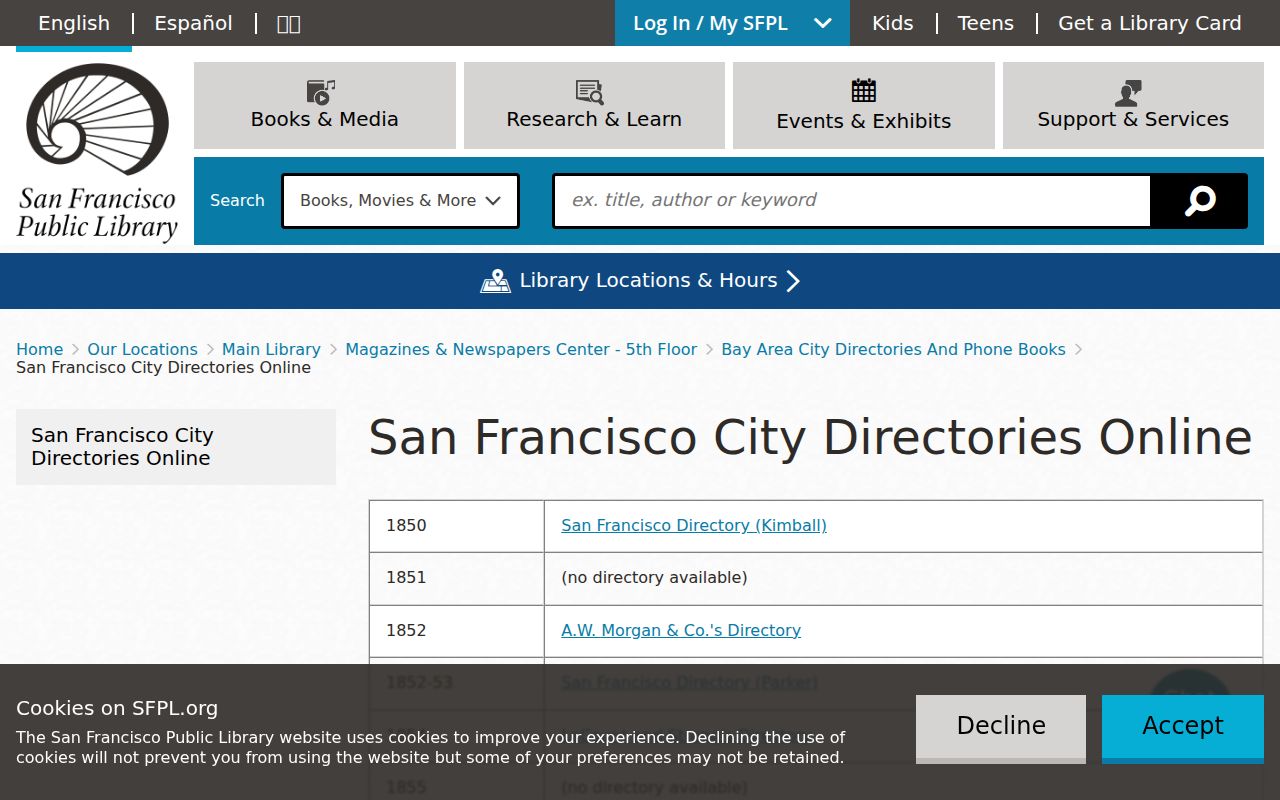
The digital view tests a spelling or likely year; the local shelf remains the fallback for missing scans, page damage, and related material.
Search the SFPL catalog, Digital Collections, and the Online Archive of California before contacting a repository. FamilySearch collection 1402856 contains 1,036,854 images from 1824-1997; a free account or affiliate-library connection may be needed. The National Archives locations route leads to NARA San Bruno at 1000 Commodore Drive, San Bruno, 650-238-3501, for federal naturalization, immigration, census, and related Northern California holdings. Cite the original custodian when a platform supplies the image.
San Francisco Directories After 1906
The April 1906 earthquake and fire destroyed much civic and commercial fabric. Three 1906 Crocker-Langley volumes and a May 1906 Relief Business Directory create a useful before-and-after set. January and October block books add address structure. Compare the same name, business, or street across them instead of treating one post-fire listing as stable.
Displacement carried people and businesses to Oakland, Berkeley, Alameda, and Emeryville. A vanished entry may reflect shelter, relocation, destruction, or omission. Pair the directory with newspapers, block books, maps, and later deed or probate evidence.
How to Read a San Francisco Directory Entry
A typical alphabetical entry starts with surname, given name, or initial. A spouse may appear in parentheses, followed by an occupation or title, business affiliation, residence marker, and street number. Later volumes may add a telephone or homeowner notation. Business pages identify proprietors or officers, while a widow notation can preserve a family link. These are clues about a listed adult or subscriber, not a full household count.
| Name | Surname, given name or initials, with a spouse sometimes in parentheses. |
|---|---|
| Occupation or title | The printed occupation, office, or business affiliation, when supplied. |
| Address | Residence marker, house number, and street; copy every mark exactly. |
| Owner or renter mark | A homeowner or other residence-status notation may appear; absence proves nothing. |
| Family clue | Widow notation, spouse, initials, or a matching business entry can connect two records. |
Photograph or transcribe the sample fields before moving through a long run. A clipped initial, house number, or spouse can separate two same-name entries. A missing child, boarder, or household member is not surprising.
- Criss-cross directory
- An address-ordered section that connects a street to a listed occupant.
- Householder index
- A name aid pointing to the principal householder or listed adult.
- Abbreviation key
- The volume's explanation of marks such as r, h, bds, and occupational terms. Meanings can shift.
Read the abbreviation page first. The marks r, h, and bds recur across the San Francisco city directory shelf, but their exact expansion and occupational shorthand can shift by publisher and year. Preserve an unclear mark in its printed form and note any interpretation separately.
Search variants matter as much as the key. Try initials, married and widow conventions, Spanish multi-part surnames, accent-stripped spellings, and Chinese names in alternate order or romanization. The 1949 Chinese Directory and community newspapers can correct a false negative. When OCR is available, search the normalized spelling and the image because damaged Gothic type, hyphenated lines, and non-English names can defeat a hit.
Save the year, publisher, page, exact name, spouse or widow notation, address, and any business or telephone detail. That citation helps separate a source omission from a real change.
San Francisco Address-First Directories
Address-first work becomes easier in 1953, when reverse directory access begins in the listed SFPL holdings. Haines reverse directories extend from 1976-2021. Earlier tools include the 1933 San Francisco, Colma, and Daly City street list, the 1936 microfilm list, and the 1940 House and Street Directory. Label the source type for each result.
Telephone books add a second address clue: 1899-1992 are on microform, 1921-current in print, and 1901-1975 through the Library of Congress. Historical voter registers cover 1900-1968, with San Francisco address searching useful for 1900-1940 through Ancestry Library Edition onsite. Neither source is a complete household record.
For current address-keyed work, the San Francisco street directory workflow belongs with parcel and official records. The historical shelf supplies an earlier listed-person layer, not proof of present residence.
San Francisco City Directories and Census Years
Pair a directory year with the nearest census. California's 1852 state census bridges the Gold Rush period, while federal schedules are public through 1950 under the 72-year rule. A census records household relationships on its enumeration date; a city directory may list only principal adults or subscribers each year. Their differences are useful side by side.
The 1890 federal census loss is a major gap. Early city directories, the 1852 state census, newspapers, voter registers, and address lists matter more for that decade. Phone books, probate, obituaries, deeds, yearbooks, and Sanborn maps from 1886-1991 narrow later gaps, but maps do not name every person.
The National Archives facilities page starts the federal route, including NARA San Bruno. SFPL may be faster for a first pass; NARA can clarify federal series and holdings.
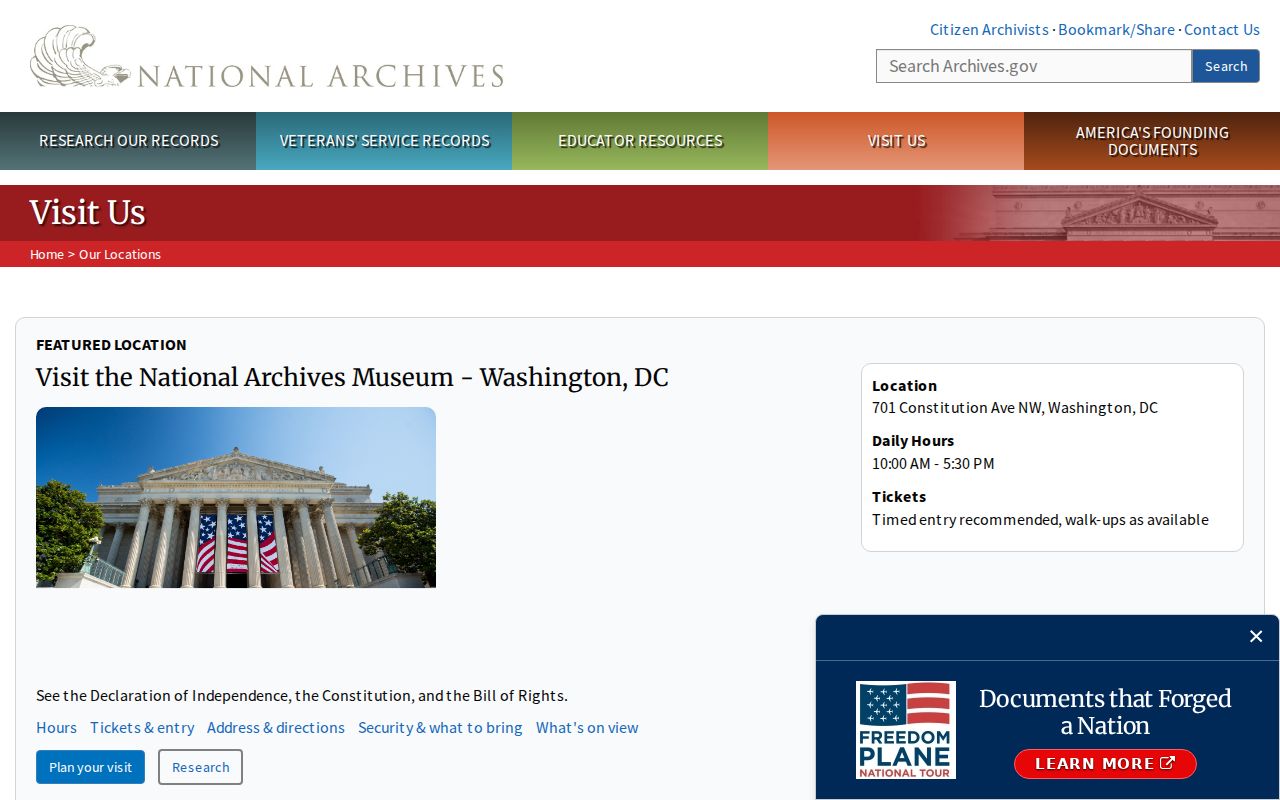
The federal route checks a San Francisco city directory year when an image is incomplete or a family crossed the boundary after it changed in 1856.
San Francisco City Directories for Family History
A household trail works best when each year is a dated observation. Start with a known event, keep the spelling, and pair a name with an address and an independent source.
- Choose a target year. Begin with a birth, marriage, death, move, school yearbook, newspaper notice, or other dated event.
- Read the alphabetical entry. Copy the name, initials, spouse or widow notation, business detail, address, and abbreviation key reference.
- Check one year on each side. A move, publisher omission, changed initial, or new spouse may explain a break in the sequence.
- Use the right address tool. From 1953, test a reverse section; before then, use the 1933, 1936, or 1940 address-first substitute, a voter register, or a block book.
- Pair the result. Compare a census year, telephone book, obituary, probate file, newspaper, or deed before treating the directory as settled evidence.
If a person disappears, test a street renaming, renumbering, cross-Bay move, death, publisher gap, or omission. Probate or an obituary may identify survivors, while a yearbook can place a student or classmate in a school setting. Strong family history is a chain of dated records.
San Francisco Research Companions
Newspapers and obituary files add detail that a city directory lacks. SFPL's Chronicle archive reaches from 1865 onward, and Examiner coverage reaches 1865-2007. Search OCR with surname variants, an exact street, spouse, business, or organization, then browse the image when the date is known. OCR can miss damaged Gothic type, hyphenated lines, and non-English names.
An obituary is family-supplied narrative, not a vital certificate. It may identify survivors, affiliations, a funeral home, or a move to Colma that points to probate and directory records. SFPL obituary help is limited to ten names per patron per month with no guaranteed match. Yearbooks, community newspapers, funeral-home records, Medical Examiner records from 1906-1956, naturalization indexes, and probate images test a name or address.
The Online Archive of California leads to finding aids for religious, ethnic, labor, fraternal, health, and community collections. Local university, community, and historical-society archives add context where a mainstream city directory is thin. Finding aids do not make private membership lists public; follow donor and repository limits.